IB Diploma vs Swiss Matura: What’s the Best Choice for Your Child?

For families in Switzerland, especially those looking to stay, the choice between the IB Diploma vs Swiss Matura is a considerable one. It shapes which universities they can apply to, which language they’ll study in, how they’re taught, and how much flexibility they have if your family moves abroad again. Both programmes are academically demanding and widely respected, but each is designed to support a different type of student and a different path forward.
IB Diploma vs Swiss Matura at a glance
Before getting into the details, here’s a side-by-side comparison of the two programmes across the factors that matter most to families.
| Feature | IB Diploma | Swiss Matura |
|---|---|---|
| Best for | International or mobile students | Students rooted in the Swiss system |
| University access | Global, including UK, US, and Switzerland | Primarily Swiss universities; some international |
| Programme length | 2 years (Grades 11-12) | 4 years (Grades 9-12) |
| Subject structure | 6 subjects across set groups + core | Broad compulsory curriculum, some electives |
| Language profile | Primarily English (some bilingual options) | Swiss national language (German, French, Italian) |
| Academic focus | Conceptual, inquiry-based | Knowledge-based, examination-focused |
| Assessment style | Mix of exams and internal assessment | Largely written and oral national exams |
| Workload | Very high, especially in final year | High, sustained across four years |
| Flexibility | High subject choice within groups | More fixed curriculum |
| Main advantage | International university recognition | Direct route to Swiss universities |
| Main challenge | Less direct alignment with Swiss entry | Limited international portability |
The table makes one thing clear: the IB Diploma vs Swiss Matura decision is not really about which programme is harder or more prestigious. It comes down to where your child is likely to study after high school, which language they are strongest in academically, and how well they thrive with structure versus independence.
What is the IB Diploma?
The International Baccalaureate Diploma Programme (IB DP) is a two-year pre-university qualification taken in Grades 11 and 12, typically between the ages of 16 and 19. It was developed in Geneva in the 1960s, so the Swiss education system has a long history with it.
Students study six subjects, one from each of the IB’s subject groups: language and literature, language acquisition, individuals and societies, sciences, mathematics, and the arts. Three are taken at Higher Level (HL) and three at Standard Level (SL). This structure means students keep breadth while going deep in their strongest areas.
On top of the six subjects, students complete three core components: Theory of Knowledge (TOK), an Extended Essay of around 4,000 words, and Creativity, Activity, Service (CAS). These are what make the IB distinctive. TOK in particular asks students to think critically about how we know what we know, which universities find valuable.
Assessment is a combination of external written exams and internal assessments marked by teachers and moderated by the IB. Final grades run from 1 to 7 per subject, with a maximum of 45 points including the core. Most universities consider a score of 30 or above a solid result. Entry to highly competitive Swiss institutions is a different matter: ETH Zurich, for example, requires 38 out of 42 subject points (excluding bonus points) for IB applicants, with Higher Level passes in specific subjects. Final results for the IB come out in July.
The IB is recognised by universities in Switzerland, though the entry requirements vary by institution and programme.. You can read more about how Swiss universities accept the IB Diploma here.
When is the IB Diploma the better choice?
The IB suits students who are curious across subjects, not just strong in one or two. It works well for self-directed learners who can manage a heavy workload without constant external structure.
It’s the stronger option if your child may apply to universities outside Switzerland, particularly in the UK, US, Canada, or the Netherlands, where the IB is widely understood and respected. If your family might relocate before university, the IB travels with you. A student who starts IB in Zurich can finish it in London or Singapore.
It’s also worth considering if English is your child’s strongest academic language. Most international schools in Switzerland teach primarily in English, and the Extended Essay and TOK work demand real written precision.
What is the Swiss Matura?
The Swiss Matura (known as Maturité in French-speaking Switzerland, Maturità in Italian-speaking cantons, and Maturität in German-speaking regions) is Switzerland’s national school-leaving qualification. It’s a four-year programme, typically running from Grade 9 to Grade 12, and is the standard route through the Swiss Gymnasium.
Students follow a broad compulsory Swiss curriculum covering languages, mathematics, sciences, humanities, and the arts. They also choose a major subject area (Schwerpunktfach) and complete a Maturaarbeit, an independent research paper in their final year. Assessment is primarily through written and oral national examinations, with results determining university admission directly.
Instruction is delivered in one of Switzerland’s national languages: German, French, or Italian, depending on the canton. This has practical implications for students whose strongest academic language is English; the Matura is a demanding programme and doing it in a second or third language adds a significant layer of difficulty.
Assessment is primarily through written examinations, with a standardised national procedure for the Federal Matura. It is worth noting that the Hausmatura, offered at some secondary schools, follows a different procedure and its recognition varies by university and country.
When is the Swiss Matura the better choice?
If your child is well integrated into the local Swiss language and education system, the Matura is usually the most direct path forward.
It suits students who learn well through a structured national curriculum, who aren’t looking to keep options open internationally, and who are planning to study in Switzerland. For a student in canton Zurich who wants to study medicine at the University of Zurich, the Swiss Matura is simply the most logical route. It’s what the system is built around.
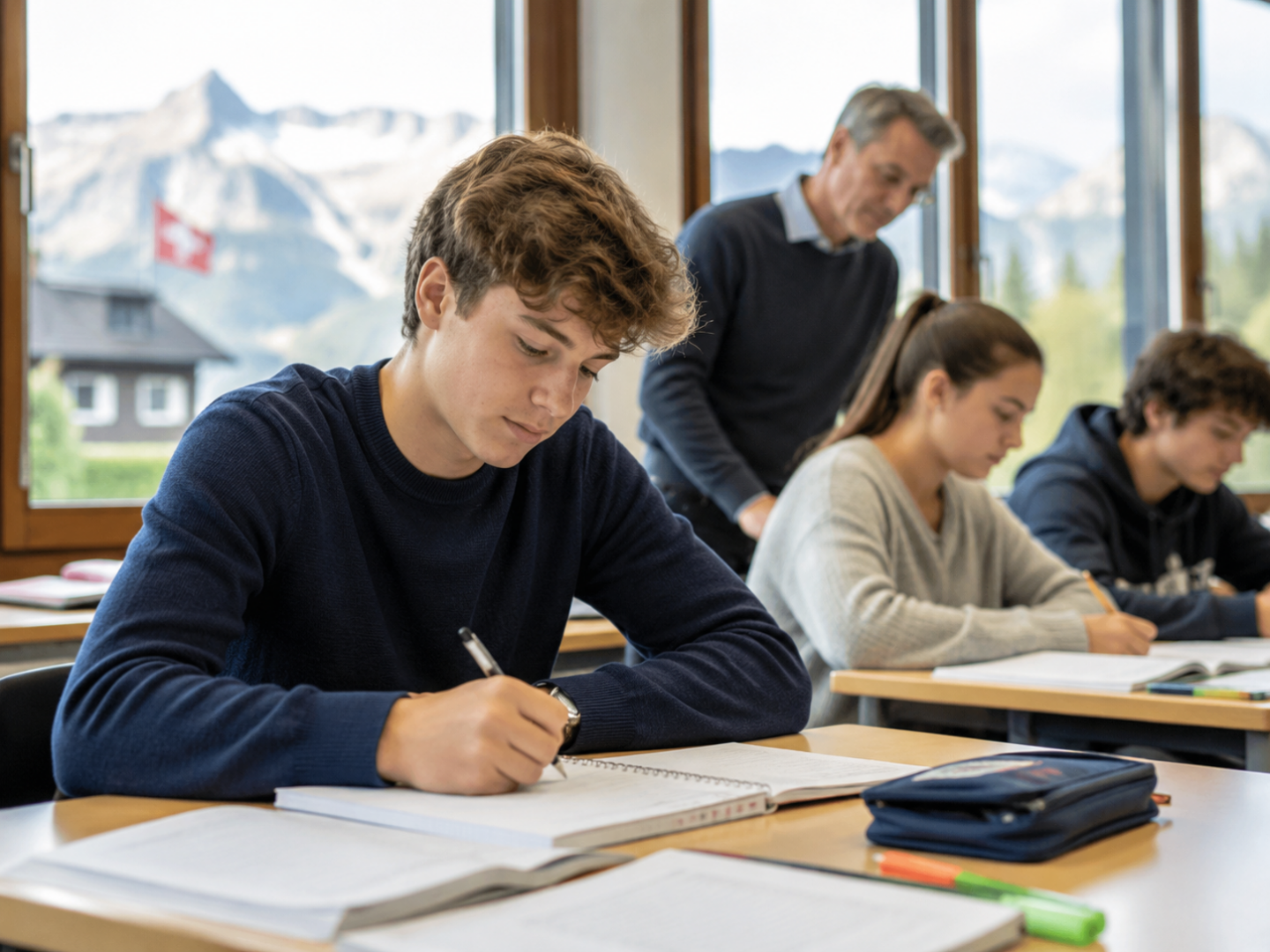
The four-year timeline also makes it better suited to students who benefit from a longer runway to develop academically, rather than the concentrated two-year intensity of the IB.
Key differences between the IB Diploma and Swiss Matura
The comparison table above gives you an outline. Here is what those differences mean in practice.
University recognition
The IB Diploma is accepted by universities in over 75 countries. UK, US, Canadian, and most European universities have clear IB entry requirements. Swiss universities also accept the IB, though students may occasionally need to meet additional language conditions depending on the institution and programme.
The Swiss Matura gives automatic access to all Swiss universities and the Federal Institutes of Technology (ETH Zurich and EPFL), without additional conditions. For students aiming at Swiss institutions, this is a significant practical advantage.
Subject choice and curriculum breadth
The IB offers more flexibility in which subjects you study at depth. Students choose within each group, meaning a student passionate about history, theatre, and biology can build a timetable that reflects that. The three Higher Level subjects allow real academic stretch.
The Swiss Matura covers a wider range of compulsory subjects across the full four years, which can be an advantage for students who are still working out what they want to study. The breadth is built in.
Language of instruction
This is often the deciding factor for families. International schools in Switzerland teach primarily in English. The Swiss Matura is taught in the local national language: German, French, or Italian, depending on the canton.
If your child is stronger in English than in a Swiss national language, the IB removes a significant barrier. If they’re schooled in Swiss German or French and are fully comfortable in that environment, switching to an English-medium school for the IB may create an unnecessary obstacle.
Workload and study approach
Both programmes are demanding. The IB’s workload is high and largely self-directed; students manage the Extended Essay, CAS commitments, and TOK alongside six subjects. The Matura’s workload is equally heavy but more structured, with a fixed curriculum and a clear national pathway. Students who are self-motivated and organised tend to do well in the IB. Students who work better with external structure and a defined programme often find the Matura a better fit.
Assessment methods
IB assessment combines external written exams with internal assessments, coursework, and the Extended Essay. This suits students who perform well across different formats. The Swiss Matura relies more heavily on written exams, which suits students who are strong test-takers and work well under traditional exam conditions.
If your child tends to freeze in high-stakes exams, the IB’s mixed assessment model may work in their favour.
How to decide which is right for your child
The table below captures the main decision points. Read it alongside what you know about your child’s learning style, your family’s plans, and which languages they’re most comfortable studying in.
| Choose IB Diploma if… | Choose Swiss Matura if… |
|---|---|
| Your child may study abroad | Your child is likely to study in Switzerland |
| English is their strongest academic language | They are strong in a Swiss national language |
| They want to be able to choose subjects | They benefit from a broad academic curriculum |
| They are independent and organised | They thrive in a structured national pathway |
| Your family may relocate internationally | Your family is settled in Switzerland |
| They are aiming for international universities | They want direct alignment with Swiss university entry |
Neither option closes every door. IB students do go to Swiss universities. Matura students do study abroad. But each programme is designed with a particular student and future in mind, and choosing the one that fits well makes the final years of high school considerably more manageable.
How TutorsPlus can help with IB Diploma or Swiss Matura
Whether your child is starting the IB Diploma or working through the Swiss Matura, having expert support at the right moment makes a real difference.
Our IB tutors in Switzerland work with students across all IB subjects, from Higher Level Mathematics to Theory of Knowledge essays. We match students with tutors who know the IB inside out, whether they need help keeping pace through the year or intensive preparation before exams.
For Swiss Matura students, our Swiss Maturité tutoring covers the full range of Gymnasium subjects, in French, German, and English. If your child is struggling with a specific subject or needs help with their Maturaarbeit, we can help.
FAQs about IB Diploma and Swiss Matura
Is Swiss Matura better than the IB Diploma for studying in Switzerland?
For most students planning to study in Switzerland, yes. The Swiss Matura gives direct, unconditional access to Swiss universities, including ETH Zurich and EPFL. IB students can also apply, but may face additional language or subject conditions depending on the institution.
Is the IB Diploma better for studying abroad?
Generally, yes. The IB Diploma is recognised by universities in over 75 countries and is well understood by admissions teams in the UK, US, Canada, and across Europe. If your child is targeting international universities, the IB is the stronger platform.
Which is harder: IB Diploma or Swiss Matura?
Both are demanding, and comparisons are tricky because the challenge is different in each. The IB concentrates pressure into two years, with significant independent work on top of six subjects. The Swiss Matura spreads the load over four years with a broader compulsory curriculum. Students who struggle with self-managed workloads often find the IB harder. Students who find sustained breadth difficult may find the Matura more taxing.
Can an IB student apply to ETH or EPFL?
Yes. Both ETH Zurich and EPFL accept the IB Diploma. You can read more in our article on Swiss university admission for IB students. Entry requirements vary by programme, so it’s worth checking directly with the university for the course your child is interested in.
Which programme is better for international families in Switzerland?
The IB Diploma is usually the better fit. It’s taught in English, it travels internationally if your family relocates, and it’s designed for students from diverse national backgrounds. International schools in Switzerland offer the IB specifically because it serves internationally mobile families well.
Is Swiss Matura taught in English?
No. The Swiss Matura is taught in the local national language: German in German-speaking cantons, French in French-speaking cantons, and Italian in Ticino. Some schools offer bilingual Matura tracks, but the programme is fundamentally rooted in Swiss national languages.
Can my child switch from Swiss Matura to IB Diploma?
Yes, though the timing matters. Moving from the Swiss Gymnasium to an IB school is most straightforward before the IB’s two-year programme begins, typically at the start of Grade 11. Switching mid-programme is more disruptive and depends heavily on the school. If you’re considering a switch, speak to both schools early.
Does an IB Diploma offer enough preparation for Swiss universities?
Yes. The IB Diploma is accepted by Swiss universities, and its academic rigour is well regarded. Some universities may ask for specific subject or language requirements, so check entry conditions for your child’s intended course. The Extended Essay and TOK components are particularly valued for programmes that expect independent academic work.
Can tutoring help with IB Diploma or Swiss Matura preparation?
Absolutely. Targeted tutoring can make a significant difference, whether your child needs help with a specific IB subject, support writing their Extended Essay, or preparation for Swiss Matura exams. Our tutors work with students at all stages of both programmes. See our IB tutoring and Swiss Maturité tutoring pages for more information.
What is the Matura equivalent of?
The Swiss Matura is broadly equivalent to A-Levels in the UK, the French Baccalauréat, or the German Abitur. It is the standard pre-university qualification in Switzerland and is recognised internationally as a university entrance qualification, though recognition varies by country and institution.